The Role of General Court of Audit in Saudi Arabia’s Fiscal Oversight: Financial Audits and Mechanisms for Good Governance of Public Funds

Author: Mr. Mohammed Almalki, Assurance Auditor at the Supreme Audit Institution of Saudi Arabia
Introduction
Public sector accounting in the kingdom of Saudi Arabia is undergoing significant transformation, shifting from cash-based to full-accrual accounting. This shift represents a strategic pillar of Vision 2030, which includes large-scale capital projects. In light of this transformation, financial audits must evolve into proactive tools that identify risks, and help redirect public resources toward citizens’ priorities, rather than solely being passive year-end exercises. In response to these changes, Saudi Arabia’s General Court of Audit (GCA) has taken on an increasingly strategic role in strengthening financial oversight and public accountability.
This article explores the critical role of GCA in advancing public sector accountability in Saudi Arabia by examining best practices. It also highlights GCA’s efforts in combating corruption and financial mismanagement, as well as the mechanisms it employs to ensure the effective use of government funds. Through case studies, it illustrates the positive impact of GCA’s audit work on citizens and national development.
Best Practices for Conducting Public Sector Financial Audits
GCA has made significant developments in strengthening public sector financial audits by developing a modern audit methodology aligned with international audit standards (ISA), embracing digital transformation, and introducing a comprehensive training platform to enhance auditor capabilities.
GCA’s financial audit methodology is guided by key principles such as institutional independence, real-time data access, and risk-based audits. Each audit begins with a structured risk assessment aligned with the International Standards of Supreme Audit Institutions (ISSAIs) (INTOSAI, n.d.), complemented by historical trend analysis derived from GCA’s digital audit platform “Shamel” that leverages big data, sourced from the government-wide procurement and payments management portal “Etimad” and other national platforms. This approach ensures that audits are not only objective, but also strategically targeted at high-impact areas, forming a backbone for credible fiscal governance.
Shamel has significantly enhanced the efficiency, precision, and responsiveness of audit operations. Through seamless integration with national platforms such as Etimad, GCA auditors access real-time transactions and financial data, allowing them to cross-verify contract values, payment schedules, and project timelines against actual financial records. The platform incorporates a wide range of smart functionalities—including automated task creation, artificial intelligence (AI)-driven analytics, and integrated reporting tools—that streamline workflows and reduce manual effort. One of its key features is “ArIF”, GCA’s Artificial Intelligence Facilitator, an AI-powered smart assistant that uses Natural Language Processing (NLP) to provide auditors with instant, personalized responses to questions to support them during audit engagements.
Furthermore, enhancing audit quality and maintaining alignment with international public sector standards requires sustained investment in auditor development. GCA addresses this through ongoing professional training in areas such as International Public Sector Accounting Standards (IPSAS) and ISSAIs, thereby strengthening their technical capabilities and supporting consistency with global standards.
As part of this commitment, GCA launched the Smart Course Library (SCL) platform, a digital training platform designed to foster continuous learning and maximize the impact of modern technology. Accessible via smart devices, the platform improves user experience, expands access to learning resources, and supports personalized professional growth. It currently hosts more than 100 specialized courses covering audit practices, IPSAS, and related technical subjects, along with over 20 structured learning paths tailored to functional audit roles.
The Role of Auditing in Combating Corruption and Financial Mismanagement
Financial audits do more than detect financial misstatements—they help in detection of financial misconduct by promoting accountability across public entities. GCA plays a critical role in this process, and regularly uncovers high-risk transactions by leveraging advanced digital tools within its Shamel platform.
GCA contributes in combating corruption and financial mismanagement by implementing a structured escalation policy that requires audited entities to submit all requested documentation within 7 working days, and respond to the audit findings within 30 days. Such response framework ensures that audit findings are not ignored but translated into corrective action. GCA’s independence further strengthens its role in enforcing accountability and allows it to escalate unresolved issues to relevant authorities when necessary.
In cases involving serious financial concerns or management override, failure to comply triggers automatic escalation to the Oversight and Anti-Corruption Authority (Nazaha). Material exceptions flagged by Shamel are shared through secure digital channels,. The national whistle-blower hotline (980) feeds citizen reports into this system. Nazaha receives an average of 47,000 reports annually, part of which requires timely involvement of GCA to provide expert input particularly in cases involving embezzlement and bribery, abuse of authority and position, and financial misconduct (Al Arabiya, 2024).
Mechanisms and Frameworks for Ensuring Accountability in the Allocation and Expenditure of Government Funds
GCA has developed an integrated accountability framework that spans the entire budget cycle, from appropriation to execution. This framework comprises several interlinked mechanisms, including real-time financial monitoring, audit follow-up systems, oversight escalation protocols, and high-level reporting tools designed to ensure both transparency and enforcement across all stages of public financial management.
At the core of this framework is the Audit Recommendation Tracking System (ARTS). This tool continuously monitors the status of audit recommendations and links them directly to financial disbursement decisions. When high-risk issues remain unresolved, ARTS notifies the Ministry of Finance—who may suspend or condition fund releases until corrective action is confirmed (AlQurashi, 2024). This mechanism transforms auditee corrective actions into a fiscal priority, reinforcing accountability across both the planning and execution phases of public funds.
Another essential element of this framework is transparency at the highest levels of governance. GCA submits its annual report directly to the King, emphasizing its pivotal role in promoting transparency and accountability within the Kingdom’s public financial management system. These reports provide a strategic overview of how well entities are adhering to fiscal priorities and whether public spending aligns with national development goals. This direct reporting line reinforces the accountability of public entities in how they manage and utilize public resources.
Case Studies of Successful Mechanisms for Good Governance of Public Funds
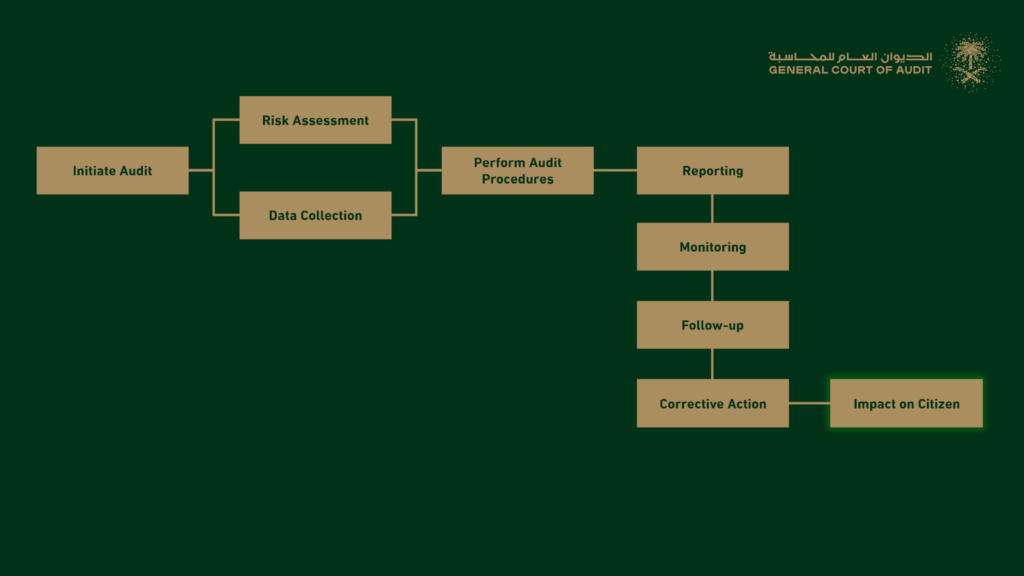
In Saudi Arabia, the General Court of Audit (GCA) plays a fundamental role in supporting operational and financial improvements across the public sector. By promoting the efficient use of public resources, GCA ensures that expenditures align with national priorities and deliver measurable outcomes for citizens. In line with INTOSAI-GUID 5260, which emphasizes the importance of strengthening internal audit functions as a fundamental component of good governance and risk management, GCA actively supports initiatives that build internal control capacity within government entities services (INTOSAI, 2019).
The following case illustrates how GCA contributes to the development of internal audit systems in the public sector—particularly within ministries responsible for delivering critical social services to the public.
Case Study: Enhancing Financial Oversight through Internal Audit Capacity in the Public Sector
As part of its ongoing commitment to strengthening the governance of public funds, GCA partnered with various ministries in the public sector to enhance internal audit capabilities. This collaboration focused on building internal structures that support accountability and improve oversight of programs with direct relevance to citizens.
The initiative involved designing a roadmap to establish a specialized training programs, aimed at equipping staff across ministries with the knowledge and tools necessary to carry out effective internal audits. The program was tailored to reflect the specific operational and financial environment of the public sector, helping institutionalize sound internal control and auditing practices (General Court of Audit, 2023).
As a result:
- Ministries received structured guidance to develop more effective internal audit functions.
- Sector-specific training plans were launched to upskill internal audit teams in financial auditing
- A stronger foundation for internal accountability and program oversight was established
While the initiative focused on internal audit capacity building, its long-term value lies in improving the overall performance and financial management within the public sector. As financial audit practices are strengthened, ministries are better positioned to manage public resources, enhance service delivery, and develop more responsive and effective programs—ultimately benefiting citizens who rely on these services.
Conclusion: A Strategic Audit Authority for Fiscal Accountability and Governance
GCA has emerged as a cornerstone of Saudi Arabia’s fiscal governance system, playing a significant role in enhancing the accountability and governance of public spending. Through the integration of advanced digital tools, such as Shamel and the Audit Recommendation Tracking System (ARTS), and its commitment to international audit standards, the GCA has transformed financial auditing to a proactive instrument for public sector improvement. As Saudi Arabia advances its Vision 2030 goals, the GCA will continue to serve as a vital enabler of reform, helping to align financial management with national priorities and public trust.

References:
- INTOSAI. (n.d.). Financial audit guidelines. https://www.issai.org/
- AlQurashi, A. (2024). GCA’s digital transformation: Innovative solutions for recommendation implementation and audit follow-up. INTOSAI Journal. https://intosaijournal.org/journal-entry/gcas-digital-transformation-innovative-solutions-for-recommendation-implementation-and-audit-follow-up/The Value and Benefits of Supreme Audit Institutions – making a difference to the lives of citizens | IFPP. (n.d.). https://www.issai.org/pronouncements/intosai-p-12-the-value-and-benefits-of-supreme-audit-institutions-making-a-difference-to-the-lives-of-citizens/
- Al Arabiya. (2024, February 25). 3 مدن سعودية الأعلى في نسب بلاغات الفساد [Three Saudi cities reported the highest rates of corruption complaints]. https://www.alarabiya.net/saudi-today/2024/02/25/3-%D9%85%D8%AF%D9%86-%D8%B3%D8%B9%D9%88%D8%AF%D9%8A%D8%A9-%D8%A7%D9%84%D8%A3%D8%B9%D9%84%D9%89-%D9%81%D9%8A-%D9%86%D8%B3%D8%A8-%D8%A8%D9%84%D8%A7%D8%BA%D8%A7%D8%AA-%D8%A7%D9%84%D9%81%D8%B3%D8%A7%D8%AF
- General Court of Audit. (2023). GCA Introductory Brochure. In https://www.gca.gov.sa/uploads/documents/Introductory.brochure.pdf.
- INTOSAI. (2019) https://www.issai.org/pronouncements/guid-5260-governance-of-public-assets/