Implementation of Strategic Management Principles in the Public Sector: The Experience of The Chamber Of Accounts Of The Republic Of Azerbaijan
Authors: Tamerlan Yusif-Zada, Chief of Staff and Narmin Jafarova, Advisor, Chamber of Accounts of the Republic of Azerbaijan
Development of the Supreme Audit Institution’s Key Strategic Document
Over the past 20–25 years, strategic management has been widely accepted as one of the methods for modernizing public policy. The Strategic Plan of the Chamber of Accounts for 2021–2025, which outlines the Chamber’s long-term development, reflects its vision, mission, core values, outcomes and outputs, and relevant activities. It was developed based on international expert evaluations and recommendations, progressive practices, the “Strategic Management Handbook for Supreme Audit Institutions,” and the principles of INTOSAI P-12 (The Value and Benefits of SAIs – Making a Difference to the Lives of Citizens). The Strategic Plan serves as a roadmap for the Chamber of Accounts’ operations from 2021 to 2025. It aims to strengthen institutional capacity and enhance the role of high-quality auditing in public financial management and oversight, through greater engagement with the parliament, government, and society.
Implementation of the Chamber of Accounts’ Strategic Plan
To implement the Strategic Plan of the Chamber of Accounts for 2021–2025, an annual Operational Plan was developed, covering all outcomes and outputs. This plan includes measures aimed at addressing weak points and potential gaps across different areas of activity, and improving performance in various dimensions — institutional, organizational, and professional.
Outcomes are medium and long-term strategic changes in the organization’s close external environment and among its stakeholders. The organization can significantly contribute to these changes (but cannot fully control them). As the final outcomes of its Strategic Plan, the Chamber of Accounts has defined:
- Contributing to enhanced accountability of public finance and strengthened fiscal responsibility;
- Strengthening trust in its activities.
Outputs are results that are under the organization’s control. As intermediate outcomes of its Strategic Plan, the Chamber of Accounts has defined:
- Expanding the scope of performance auditing,
- Improving the selection and coverage of financial and compliance audits,
- Enhancing the quality of audits.
Achieving intermediate outcomes depends on the organization’s capacity, which consists of three distinct dimensions: institutional, organizational, and professional.
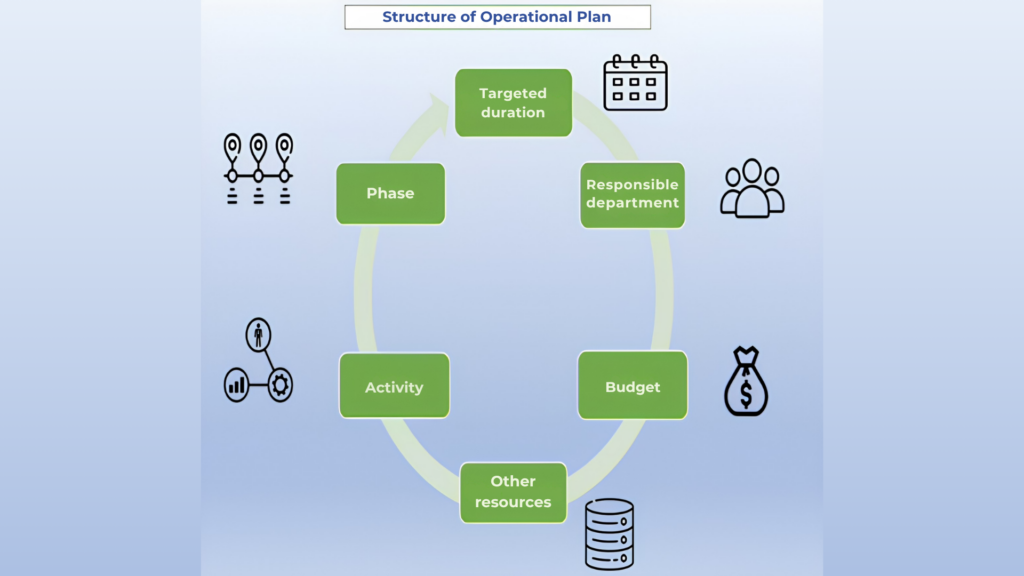
At the heart of the Operational Plan lie the “activities”. The most important requirement for this element is its capacity to contribute to the achievement of the goals set out in the Strategic Plan. Analyses show that one of the main shortcomings in many institutions’ strategic plans is the inclusion of predominantly routine (day-to-day) activities.
Monitoring and Accountability of the Chamber of Accounts’ Strategic Plan
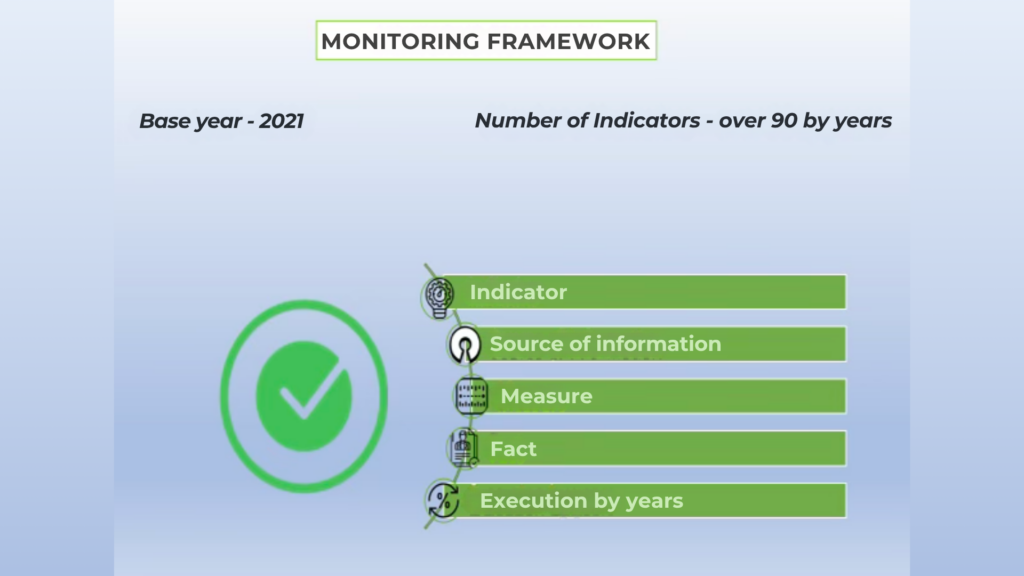
Monitoring and accountability are sometimes treated as components of the overall strategy implementation process. Establishing a monitoring framework for outcomes and outputs during the preparation of the strategy allows for the methods of measuring outcomes to be defined in advance, and helps to specify the outcomes more precisely.
At the Chamber of Accounts, a system of indicators has been developed to monitor the implementation of the Strategic Plan. This system includes over 90 key performance indicators (KPIs). It sets the frequency of assessments and defines quantitative and qualitative targets to be achieved.
To ensure that the implementation of the planned activities is measurable, at the end of each year, actual implementation is assessed by comparing it against the planned indicators.
A dedicated section on the implementation of the Strategic Plan was included in the Annual Activity Reports of the Chamber of Accounts for 2021–2024, marking the first such practice in the country. In addition, for the first time in Azerbaijan, the reporting on the implementation of the Strategic Plan was also linked to budget indicators.
Table 1 . Execution of the Operational Plan and the budget of Strategic Plan , %
| 2022 | 2023 | 2024 | |
| Operational Plan | 81,3% | 91,7% | 91,6% |
| Budget | 80,0% | 83,3% | 86% |
As seen in Table 1, the implementation of activities exceeded the level of budget execution.
Furthermore, the overall implementation status of the indicators within the Monitoring Framework remained at or above 80% during these years, which, being higher than the corresponding budget execution level, serves as an additional indicator of the effective implementation of the Strategic Plan.
The reporting practice of the Chamber of Accounts on its Strategic Plan has been recognized by international organizations (e.g., the INTOSAI Development Initiative (IDI)) as one of the best in the field, and was recommended to other Supreme Audit Institutions (SAIs). The Chamber of Accounts has even been involved as an expert in projects aimed at establishing similar processes in the SAIs of other countries.
Table 2. Extract from the 2024 Implementation Status of the Strategic Plan Monitoring Framework
| Indicator | Planned | Implementation | Status |
| Share of revenues analyzed in the opinion compared to total state budget revenues | 96,0% | 97,8% |  |
| Share of expenditures analyzed in the opinion compared to total state budget expenditures | 75,0% | 85,5% | |
| Consideration of the Chamber of Accounts’ recommendations in the Cabinet of Ministers’ Report | Yes | Yes | |
| Share of performance audits among total audits | 12,5% | 13,0% | |
| Publication rate of the Portfolio (Work Plan of the previous year) | 63% | 64,3% | |
| Implementation rate of the recommendations of Board decisions on oversight measures | 65% | 70% (operative information) | |
| Share of audits and other measures that underwent quality control out of total activities | 100% | 98% |  |
| Chamber of Accounts’ score on the Open Budget Index | 89 | 100 | |
As previously mentioned, this article focuses more on the next stages of strategic management, particularly on monitoring. In this regard, the identification of appropriate indicators for measuring progress toward objectives becomes especially important. The article also highlights the significance of key performance indicators (KPIs) in various activities and emphasizes the importance of tracking implementation status using these indicators. The goal is to support public institutions in implementing this process and to contribute to the improvement of the indicator systems in use.
The Chamber of Accounts applies outcome indicators to measure the impact of its work by utilizing strategic management principles in both its core function — public auditing — and other activities.
However, it should be noted that some indicators are not included in the Strategic Plan’s Monitoring Framework, either because the Chamber of Accounts does not have direct control over the collection of relevant data or because such indicators cannot be planned in advance. For example: Recommendations with financial impact — such as recovery of public funds, cost savings, prevention of overspending, or increased public revenues; Recommendations with procedural or compliance effects (i.e., those without direct financial effect) — such as improved legal compliance or the adoption of new regulatory documents. Although these are among the main indicators of audit activity, they are not part of the Monitoring Framework of the Strategic Plan. Nevertheless, data on these indicators are included in the Annual Activity Reports.
Thus, it can be concluded that not all good indicators can be applied for monitoring the implementation of strategic documents.
One of the most important aspects regarding the Monitoring Framework is the correct identification of indicators. Failure to define appropriate indicators may result in significant progress going unnoticed, even when the implementation rate of the Strategic Plan appears high.
Indicators must be directly linked to capacity, outputs, and outcomes. They can be expressed in quantitative or qualitative terms. Quantitative indicators are relatively easy to measure. Qualitative indicators, on the other hand, tend to be more descriptive in nature and often require additional criteria for measurement. A successful practice is to combine both types of indicators in the Monitoring Framework.
Including too many indicators in the Monitoring Framework can negatively impact the monitoring process (i.e., the system must remain manageable). In this regard, it is considered optimal to define 2–3 indicators for each outcome, and 1–2 (sometimes 3–4) indicators for each output. Additionally, indicators related to capacity may also be included in the relevant framework.
The inclusion of many indicators in the Monitoring Framework by the Chamber of Accounts is due to various reasons. Broadly, this reflects the first-time application of a results-based framework, with plans to optimize the number of indicators in future strategic documents. It also includes the use of indicators that can measure not only outcomes and outputs but also capacity, and considers the Chamber’s ability to collect relevant data within a short timeframe. For example, indicators such as: Number of audits, ratio of published audit reports to the total portfolio, number and implementation rate of recommendations issued, number of quality-controlled audit activities are all under the direct control of the institution.
At the same time, it is possible to classify indicators in the Monitoring Framework as “good” or “poor”. The table below provides some examples of training activities.
Table 3. Good and Poor Indicators (Using Training Activities as an Example)
| Expected outcome of strategy | Poor indicator | Weakness | Good indicator | Advantage |
| Competent staff in financial audit | Number of staff who have received financial audit training | Unclear what kind of training is meant; lacks specificity | Number of staff certified with PESA in financial audit | Reflects the required competence, qualification, and experience; certification is mentioned |
| Increase in participants of quality financial audit training | Increase in the number of trainings | Vague — unclear what specific training is referred to | Ratio of staff completing PESA training to total staff in this area / Number of PESA-certified staff as a proportion of total staff in this area |
For institutions newly adopting strategic management, the use of poor indicators may be acceptable in early years, but should be replaced with better indicators over time.
Other Strategic Documents of the Chamber of Accounts
In recent years, the Chamber of Accounts has expanded its strategic management practices across different domains. The aim is to ensure that activities in all areas are structured and implemented in line with the institution’s strategic goals for the medium term and are assessed based on performance indicators. This includes the development and implementation of a communication strategy, training strategy, and human resources strategy.
Consequently, it can be concluded that in the implementation of principles aimed at creating value for society and enhancing the quality of public sector governance, the role of strategic management is once again emphasized. The Chamber of Accounts intends to continue its efforts to share its exemplary practices with other institutions in the relevant sector to promote the wider adoption of strategic management approaches.
References:
- Paul Joyce – Strategic Management in the Public Sector;
- John M. Bryson – Strategic Planning for Public and Nonprofit Organizations;
- Strategic Management Handbook for Supreme Audit Institutions;
- SAI PMF (Supreme Audit Institutions Performance Measurement Framework);
- INTOSAI P-12 (The Value and Benefits of Supreme Audit Institutions – Making a Difference to the Lives of Citizens).