U.S. GAO’s Fraud Estimates: Key Steps Ensure Decision-Makers Fully Accept and Understand Innovative Approaches

Authors: Kathleen Donovan, Heather Dunahoo, Tonita Gillich, Lauren Kirkpatrick, Nicholas Weeks, U.S. Government Accountability Office
Over the past several years, the U.S. Government Accountability Office (GAO) estimated fraud facing the U.S. government using rigorous approaches that helped communicate the extent and impact of fraud in federal programs to Congress, the American public and antifraud professionals.
In 2024, GAO estimated annual government-wide fraud losses for the first time. These losses totaled between $233 billion and $521 billion annually, based on data from fiscal years 2018 through 2022.1 This amount represents three to seven percent of annual federal spending during the same period. And, in 2023, GAO estimated that the total amount of fraud within U.S. unemployment insurance programs likely fell between $100 billion and $135 billion from April 2020 to May 2023—about 10 to 15 percent of unemployment insurance benefits distributed during this time.2
Both estimates, though different in scope, provide powerful insights into the extent of fraud losses and highlight the significance of fraud affecting federal programs and operations, including fraud committed during the COVID-19 pandemic.
Before GAO’s fraud estimates, federal agencies, policymakers, and the public lacked a robust understanding of how much public money was lost to fraud. In response to a GAO survey, federal program managers acknowledged that understanding the extent of fraud loss is an important factor to consider when managing fraud risk.3 However, some federal program managers did not believe fraud was a significant problem in their program. GAO’s fraud estimates, especially the estimate of government-wide fraud, brought greater attention and clarity to the extent of fraud in government programs.
GAO took a few key steps to ensure that its fraud estimates would withstand the scrutiny of a potentially skeptical audience and that decision makers would understand and use the estimates. These steps included carefully developing the estimates, appropriately framing the results, and conducting extensive outreach to a wide variety of audiences.
Developing Fraud Estimates
GAO used the same fundamental building blocks for both estimates. The figure below provides an overview:
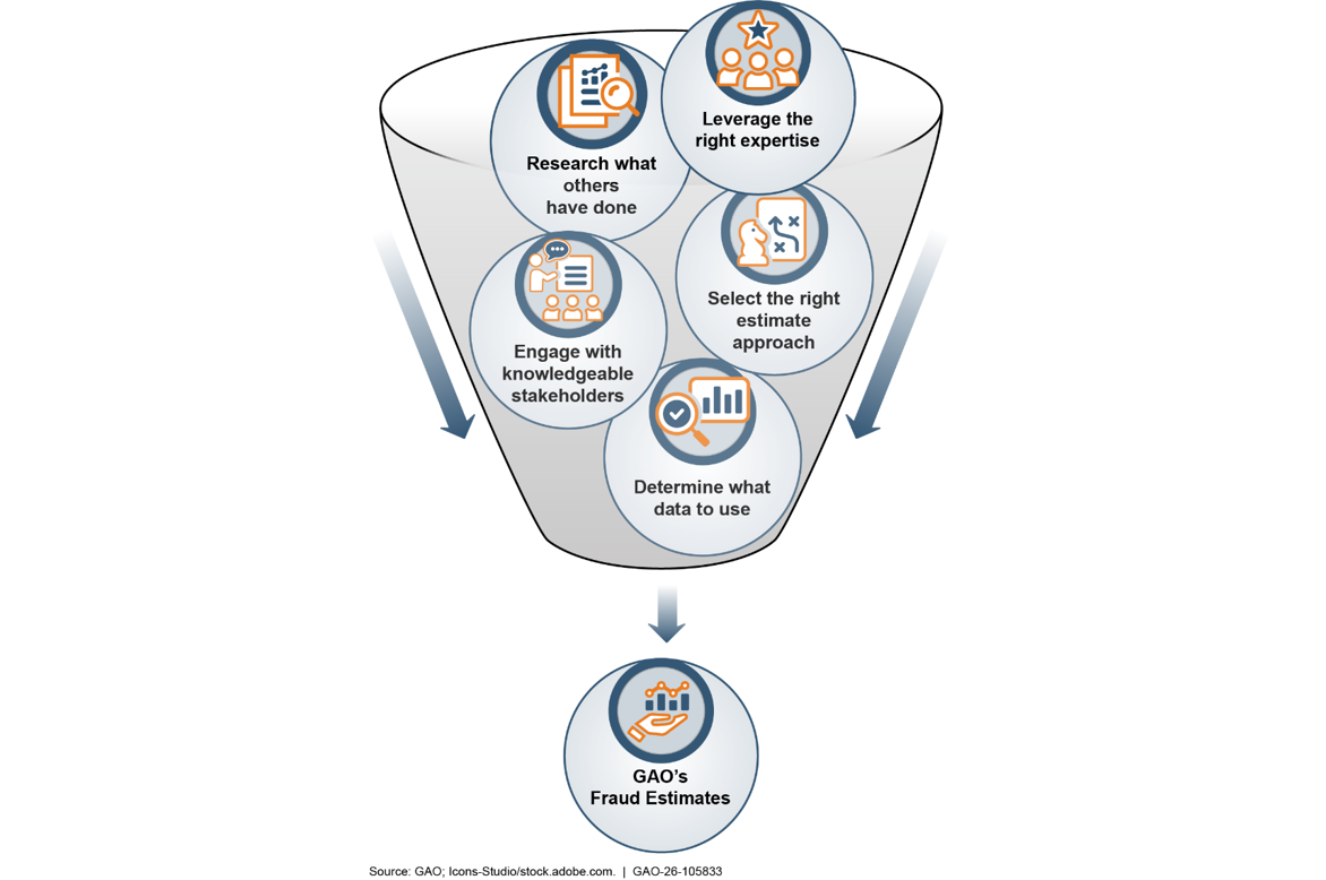
- Leverage the right expertise. GAO formed diverse teams to develop its fraud estimates. Teams included experts from across GAO with deep understanding of fraud, economists, methodologists, statisticians, and attorneys.
- Research what others have done. Before the analysis, teams conducted extensive research on other fraud estimation work to identify potential methods and considerations. This research also helped teams validate GAO’s estimates later in the process.
- Engage with knowledgeable stakeholders. GAO met with law enforcement professionals, program officials, experts in academia, and other oversight professionals to discuss approaches, data, theory, and results.
- Determine what data to use. GAO spent several months identifying and understanding different data sources available to use in its statistical models for each estimate. Each data source had its own unique considerations that could create biases and limitations. After identifying potential data sources, the teams selected, analyzed, and organized the data for the final estimation process.
- Select the right estimate approach. GAO’s two fraud estimates did not use the same approach and the right estimation approach depends heavily on the data available and the aims of the estimate. According to GAO’s Chief Statistician, Jared Smith, “When fraud is associated with individual records, it may be possible to use a statistical sample of those records to estimate fraud to a broader population. GAO used this approach to estimate unemployment insurance fraud during the pandemic. When looking at fraud at a broader level, as GAO did with its government-wide fraud estimate, statistical modeling with Monte-Carlo simulation served as a more powerful tool.” Monte-Carlo simulation, a method that can be used to estimate ranges for events where there is a high degree of uncertainty or for which there are limited data, used in the government-wide fraud estimate, was appropriate given the uncertainty associated with estimating fraud and the limited quality data available on government-wide fraud.
- Verify and validate. GAO’s estimates underwent extensive verification and validation. GAO carefully assessed the reliability of the data used in the estimates including through interviews with knowledgeable agency officials. The models’ assumptions and approaches were reviewed internally and in coordination with outside experts and also compared against fraud measurement and estimation studies. The results of the models were examined including through sensitivity testing. Each step in the process adhered to GAO’s quality assurance framework, reflecting our rigorous standards for documentation and independent review.
GAO’s Approach to Communicating its Fraud Estimates
GAO presented both its government-wide and unemployment insurance fraud estimates in public reports with appropriate context, including background information on federal program fraud and guidance on how to interpret the estimates.
The government-wide estimate report also included a detailed discussion on how estimates support program integrity. For example, fraud estimates can help demonstrate the scope of the problem, improve oversight prioritization, and demonstrate the return on investment to fraud risk management.
The unemployment insurance estimate report described the unique eligibility requirements and internal control weaknesses related to the temporary expansion of unemployment insurance programs during the COVID-19 pandemic.
By framing the fraud estimates in the larger context of fraud risk management, GAO provided critical information necessary to fully understand and use these estimates appropriately. For example, GAO explained the risk environments reflected in the government-wide estimate and how the estimate contrasted to estimates of improper payments.
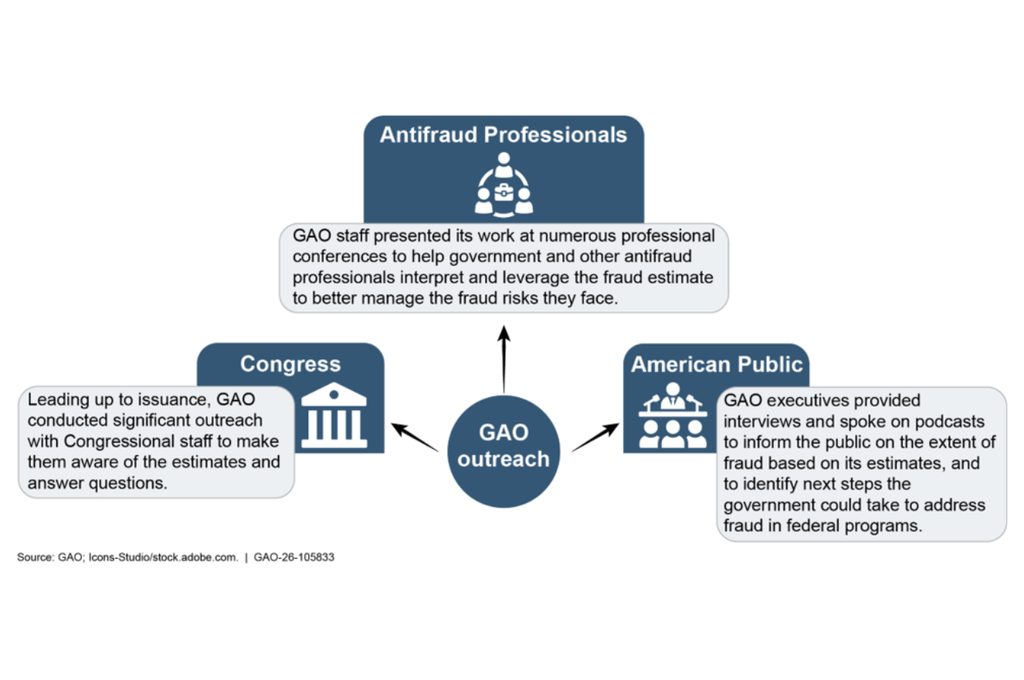
Conducting outreach to a variety of audiences also helped communicate GAO’s estimates and encourage its adoption in managing fraud risks, as the figure below illustrates.
According to Forensic Audits & Investigative Service Director, Rebecca Shea, “Outreach during the work helped particularly with getting agreement with our recommendations. No matter how agencies felt about the number, they agreed with the value of estimation for improving fraud prevention. As a result, they agreed to implement the recommendations we made to enhance fraud estimation efforts. In fact, the U.S. Department of the Treasury is already exploring options for developing more granular fraud estimates to drive prevention and detection efforts.”
Fraud Estimation Supports the Oversight Mission
GAO’s fraud estimates complemented GAO’s oversight work. For example, the estimates complemented GAO’s 2025 update to its long-standing High Risk List, which highlights areas across the federal government with serious vulnerabilities to fraud, waste, abuse, and mismanagement, or in need of transformation. GAO updates this list at the start of each new congressional session. The estimates also supported GAO’s priority recommendations, which are recommendations that have not been implemented and warrant attention from heads of key departments or agencies because their implementation could save large amounts of money; improve congressional or executive branch decision-making on major issues; eliminate mismanagement, fraud, and abuse; or ensure that programs comply with laws and funds are legally spent, among other benefits. Each year, GAO sends letters to the heads of heads of key departments and agencies, urging them to focus on these priority recommendations.
Other SAIs could consider how such estimates could advance their respective oversight efforts. Fraud estimates could help legislative bodies, program managers, and taxpayers better understand the size and scope of fraud in public spending. The work can also help SAIs identify and address weaknesses with existing efforts to measure and combat fraud, while also helping governments determine the right level of antifraud investments. Such estimates serve as benchmarks for calculating the return on investments in prevention and detection activities. Furthermore, they are foundational to demonstrating the integrity within program administration. According to former U.S. Comptroller General Gene Dodaro, “in addition to helping people understand what is lost to fraud, fraud estimates can help prioritize oversight agendas by identifying government programs particularly at risk for significant fraud losses.” He further noted that fraud estimates could also support recommendations related to preventing detecting fraud and responding to fraud. And in 2026, Acting U.S. Comptroller General Orice Williams-Brown highlighted GAO’s fraud estimates as part of Congressional testimony on GAO’s efforts to address fraud, waste, and abuse in federal programs—specifically noting both completed and future fraud estimates as critical to this effort.
Footnotes
- GAO, Fraud Risk Management: 2018-2022 Data Show Federal Government Loses an Estimated $233 Billion to $521 Billion Annually to Fraud, Based on Various Risk Environments, GAO-24-105833 (Washington, D.C.: April 16, 2024). ↩︎
- GAO, Unemployment Insurance: Estimated Amount of Fraud During Pandemic Likely Between $100 Billion and $135 Billion, GAO-23-106696, (Washington, D.C.: Sept. 12,, 2023). ↩︎
- GAO, Fraud Risk Management: Agencies Should Continue Efforts to Implement Leading Practices, GAO-24-106565 (Washington, D.C.: Nov. 1, 2023). ↩︎