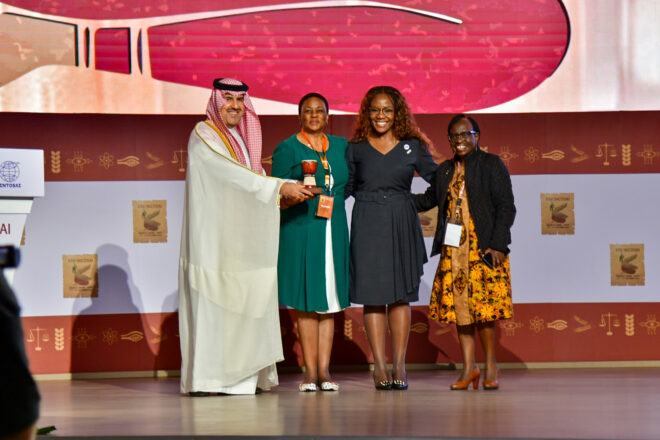
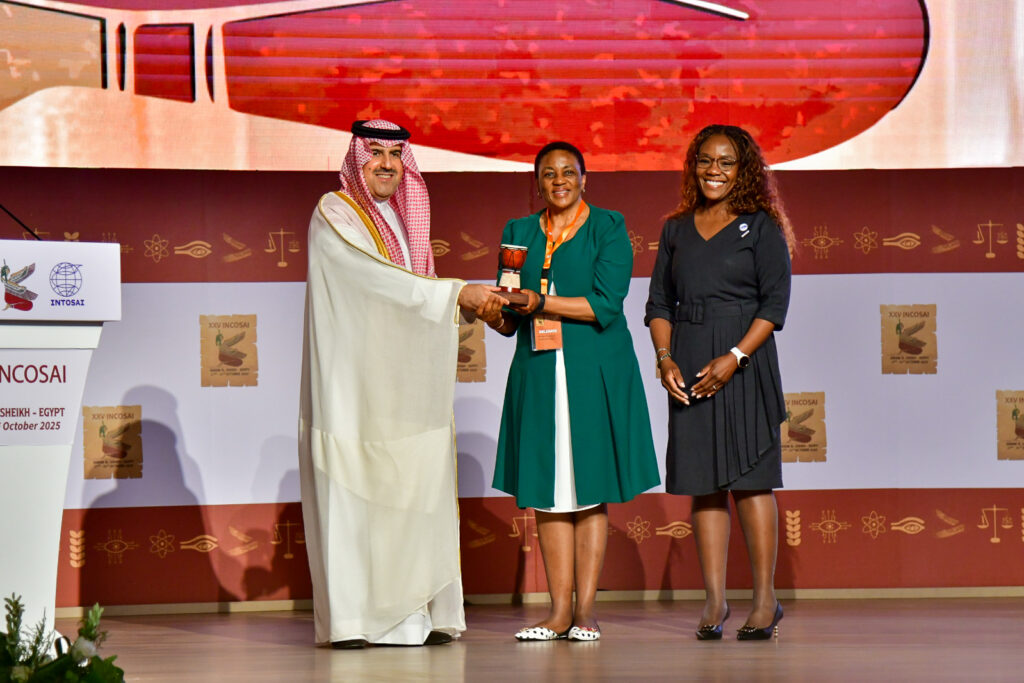
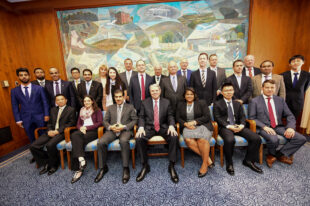
Auditor General of South Africa Tsakani Maluleke and President of the General Court of Audit of Saudi Arabia, Dr. Hussam Alangari, present the Kimi Makwetu Award to Meisie Nkau, CEO of AFROSAI-E and AFROSAI-E Chairperson, Nancy Gathungu, Auditor General of Kenya. Source: INTOSAI Journal
Author: Jessica Du, Editor and Vice President, International Journal of Government Auditing
The Kimi Makwetu Award was presented to AFROSAI-E by the International Organization of Supreme Audit Institutions (INTOSAI) at the XXV INCOSAI in Sharm El-Sheikh, Egypt. The INTOSAI Kimi Makuetu Award spotlights the best of capacity building in the INTOSAI community, and honors institutions that demonstrate outstanding commitment to strengthening the skills, systems, and sustainability of Supreme Audit Institutions (SAIs) worldwide.
The award was presented by the Auditor General of South Africa and Chair of the Capacity Building Committee, Tsakani Maluleke, and President of the General Court of Audit of Saudi Arabia, Dr. Hussam Alangari and Chair of the Policy, Finance and Administration Committee, to Meisie Nkau, CEO of AFROSAI-E and AFROSAI-E Chairperson, Nancy Gathungu, Auditor General of Kenya, who accepted the award on behalf of AFROSAI-E.
President of the General Court of Audit of Saudi Arabia, Dr. Hussam Alangari (left), and Auditor General of South Africa Tsakani Maluleke (right) present the Kimi Makwetu Award to Meisie Nkau, CEO of AFROSAI-E (center). Source: INTOSAI Journal
Since its establishment in 2005, AFROSAI-E has been dedicated to supporting English-speaking SAIs in Africa. Its mission is to enhance SAIs’ institutional capacities to effectively fulfill audit mandates, making a tangible difference in the lives of citizens.
AFROSAI-E has played a pivotal role in building capacities for its members by providing applicable resources related to audit methodologies, audit manuals, and developing a range of tools. These initiatives have empowered SAIs to produce high-quality, standardized audit products in alignment with international standards. Additionally, AFROSAI-E has implemented a comprehensive suite of capacity-building programs, including specialized workshops, certification courses, and e-learning initiatives. These efforts have significantly enhanced auditors’ technical skills and competencies. Through its learning management system (AFROSAI-E-learning Platform), AFROSAI-E has enabled more auditors to develop their skillsets, improving the technical proficiency and capabilities of its member SAIs. As a result, auditors are better equipped to carry out rigorous performance, financial, compliance, and IT audits, contributing to greater public sector accountability and transparency.
In addition to strengthening technical auditing skills, AFROSAI-E has supported the development of organizational capacity within its member SAIs. AFROSAI-E has helped enhance strategic planning initiatives, offering tailored advisory support. This has enabled SAIs to modernize their institutional frameworks, improve governance, adopt best practices in resource management, and build strong management capacities, all while delivering impactful and timely audit outcomes. AFROSAI-E’s strategic leadership development program has helped improve the leadership and management competencies of member SAIs, shifting their organizational mindset toward broader, value-oriented approaches to public accountability.
AFROSAI-E has also played a key role in assisting member SAIs with strategic planning. Utilizing its strategic planning toolkit, AFROSAI-E has provided hands-on support to help SAIs revise their strategies, incorporate stakeholder feedback, and align strategies with national public financial management reforms. In addition, the organization has strengthened member SAIs’ communications and stakeholder engagement functions, which has enhanced their credibility, public trust, and visibility.
In response to evolving challenges, AFROSAI-E has championed adaptive capacity building by promoting innovation, digital transformation, and responsiveness to emerging risks such as climate change, extractive industries, anti-corruption, and governance reforms. This proactive approach has helped SAIs remain relevant in the face of external pressures, positioning them as trusted agents of change within their national accountability ecosystems. AFROSAI-E actively tracks threats to SAI independence, offering legal advisory services and advocacy toolkits.
AFROSAI-E remains deeply engaged in partnerships with regional and global institutions, as well as development partners, to ensure sustainable support for its members. These collaborations provide not only technical knowledge transfer but also continued access to funding and expertise. Through these efforts, AFROSAI-E continues to strengthen its role as a key driver of transparency, accountability, and good governance in the African auditing community.
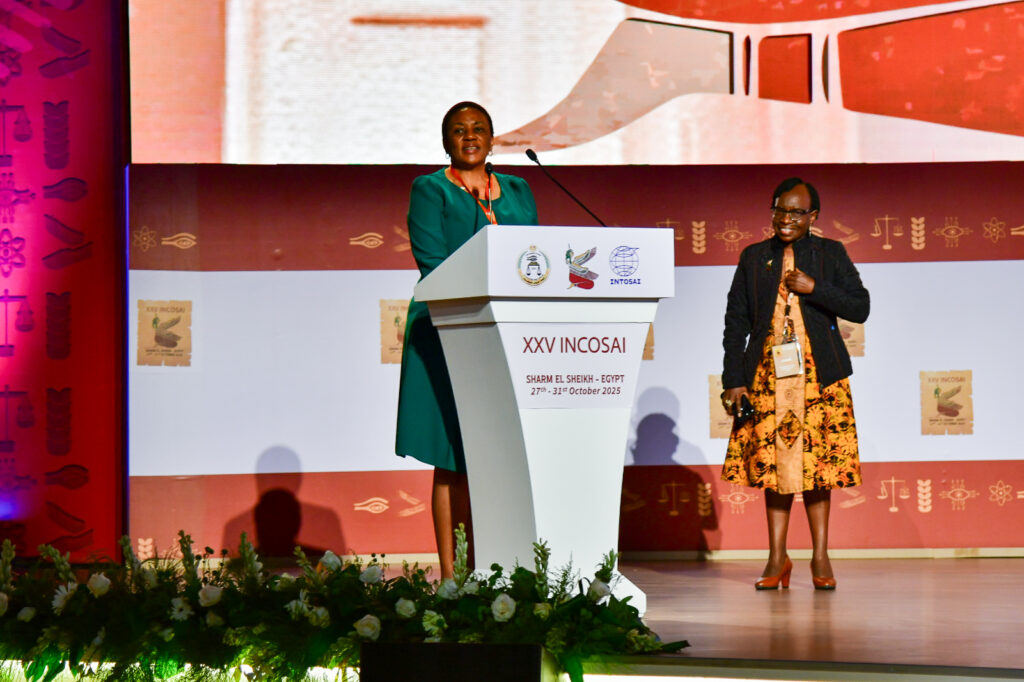
Meisie Nkau, CEO of AFROSAI-E shared,
“We are deeply honoured to receive this recognition in the name of Kimi Makwetu, whose legacy continues to inspire our work in advancing good governance and accountability across the continent.”
Meisie Nkau, CEO of AFROSAI-E, accepts the Kimi Makwetu Award. Source: INTOSAI Journal
The Kimi Makwetu Award is named in honor of INTOSAI Capacity Building Committee Chair from 2013-2020 and former Auditor General of South Africa, Mr. Kimi Makwetu, who passed away in November 2020. Auditor General Makwetu was passionate about capacity building. His leadership empowered staff and citizens; strengthened transparency and good governance; promoted ethical leadership and value-added activities; and cultivated a culture of integrity and accountability. He left an enduring positive impact on the INTOSAI community.
Mr. Abdelkader Benmarouf, President of the Algerian Court of Accounts (COA), presented the COA Evaluation Report on the 2017 Financial Regulation Preliminary Draft Law to the National People’s Assembly Finance and Budget Committee on June 11, 2020. The report…
INTOSAI’s members agree—a decisive contribution to improving professionalization requires a commitment from across the entire organization in order to develop the professional capacity and support all Supreme Audit Institutions (SAIs). Ultimately, the goal is to enable SAIs to deliver timely, relevant high-quality products. INTOSAI plans to address professionalization across the organization through three major initiatives…
The International Organization of Supreme Audit Institutions (INTOSAI) Working Group on Financial Modernization and Regulatory Reform (WGFMRR) continues to make substantive progress promoting knowledge sharing and enhancing its capacities. During the WGFMRR 4th annual meeting…