The XXV INCOSAI: A Renewed Audit Vision for a Rapidly Transforming World
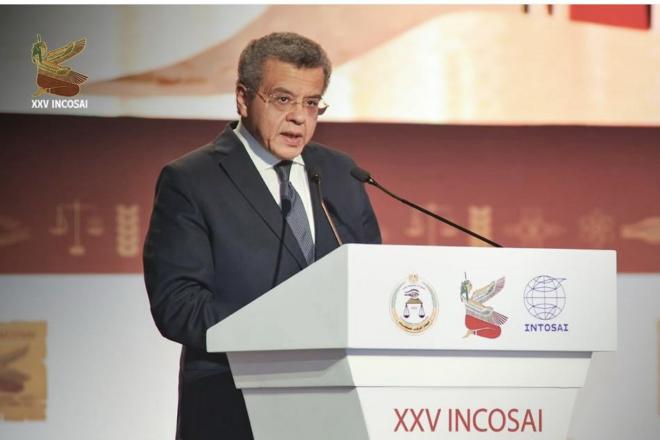
Author: Counsellor Mohamed El-Faisal Youssef, President of the Accountability State Authority of Egypt, Chair of INTOSAI.
Within the context of the long-standing journey of the International Organization of Supreme Audit Institutions (INTOSAI), and its role as a unifying international framework that entrenches the professional values of independence and integrity, the convening of the XXV INCOSAI represented a qualitative milestone in the evolution of global public sector auditing. It reaffirmed the ability of Supreme Audit Institutions (SAIs) to keep pace with the accelerating transformations occurring worldwide, particularly in the financial and economic spheres.
The Arab Republic of Egypt, represented by the Accountability State Authority (ASA)—Egypt’s Supreme Audit Institution— was honored to host this prominent international event in Sharm El-Sheikh during October 27-31, 2025, under the gracious patronage of His Excellency President Abdel Fattah El-Sisi, President of the Arab Republic of Egypt. This reflects the Egyptian State’s recognition of the importance of the auditing function as a fundamental pillar for enhancing good governance, consolidating the principles of transparency and accountability and safeguarding public funds.
Prior to the Congress, the INTOSAI Governing Board convened on the 27th and 28th of October 2025. During this Meeting, the Governing Board member SAIs discussed the reports of the INTOSAI Chair, of the Vice-Chair, the General Secretariat, the Goal Chairs, as well as key related organs, foremost among them the International Journal of Government Auditing (IJGA) and the INTOSAI Development Initiative (IDI), in addition to reviewing reports on the activities of INTOSAI’s Regional Organizations. These discussions reflected the depth of institutional integration within the Organization and the commitment of its members to aligning the strategic vision with priorities of practical implementation and capacity building.
On 29 October 2025, the XXV INTOSAI General Assembly was officially inaugurated in the presence of His Excellency Dr. Mostafa Madbouly, Prime Minister of Egypt, along with a number of high dignitaries, ministers and representatives of the Egyptian Government, conveying a clear message of institutional appreciation for the significance of the event and the growing recognition of the pivotal role played by SAIs in supporting public policy stability and enhancing citizens’ trust in the State’s institutions.
In this regard, the XXV INCOSAI witnessed a broad international participation from within and beyond the INTOSAI community, reflecting the high standing and global weight of the event within the global oversight arena. The total number of participants was about 650 participants, representing nearly 145 Supreme Audit Institutions and organs under the umbrella of INTOSAI, including high-level delegations from international organizations with shared interests in governance, accountability and sustainable development. This embodied the inclusive nature of the Congress and underscored the expanding scope of interaction and integration among the various actors within the international accountability ecosystem.
The Congress addressed two key technical themes that incarnated the core of in-depth discussions among member SAIs. The first technical theme, entitled “The Role of Supreme Audit Institutions in Auditing Central Banks and Government Activities during Financial and Economic Crises” and chaired by the U.S. Government Accountability Office (U.S. GAO), encompassed dimensions related to strengthening oversight frameworks in times of uncertainty and achieving a careful balance between independence, transparency and risk management. The second technical theme, chaired by the Accountability State Authority of Egypt, addressed “Using Artificial Intelligence Techniques in Auditing” as a strategic pathway for reshaping audit methodologies and transitioning from traditional models to more proactive and efficient approaches.
In addition to the key technical themes, the Congress was distinguished by organizing high-level discussion panels, carefully designed to deepen deliberations on fundamental issues that align with the essence of contemporary public sector auditing. The discussion panels, entitled “Combating Corruption and Money Laundering: Legal, Institutional and International Dimensions,” and “Prospects of Artificial Intelligence in Public Auditing: The Path toward Sustainable Governance”, were conducted within an open and interactive framework that enabled rich, multi-dimensional dialogue among decision-makers, experts and practitioners. They facilitated the exchange of national and international experiences, the presentation of pioneering experiences and best practices, and the exploration of avenues for multilateral cooperation, thereby supporting the development of a collective oversight vision better equipped to foresee and address future challenges effectively.
In this context, and in light of the paramount importance of anti-corruption issues on the international audit agenda, I personally chaired the discussion panel on “Combating Corruption and Money Laundering: Legal, Institutional, and International Dimensions” in my capacity as President of the Accountability State Authority and Chair of INTOSAI, underscoring the centrality of this issue and reflected an awareness of the interrelated dimensions and complexity of its challenges.
The discussions focused on the need for integration between legal and institutional frameworks, strengthening the preventive and oversight roles of SAIs in addressing illicit financial flows, in addition to highlighting the importance of international cooperation and information exchange, as well as emphasizing the growing role of the media as an active partner in solidifying the values of integrity and transparency alongside raising societal awareness of the risks of corruption.
The second discussion panel, entitled “Prospects of Artificial Intelligence in Public Auditing: The Path toward Sustainable Governance”, provided an advanced intellectual platform to examine the profound transformations taking place in the public sector amid the digital revolution. The session addressed issues of institutional transformation, sustainable governance and digital capacity building, in addition to presenting innovative models for knowledge exchange without data sharing and discussing the practical and ethical challenges associated with applying artificial intelligence technologies in audit work. Discussions also emphasized the fundamental role of information transparency in combating misinformation and strengthening citizens’ trust in public institutions, thereby reinforcing the position of SAIs as key actors in leading the transition toward intelligent auditing.
During the Congress’ closing session, the MAAT Initiative was introduced. This is an Egyptian initiative launched by the Accountability State Authority, stemming from a firm conviction in the importance of leveraging artificial intelligence technologies to develop audit work and enhance the use of modern technology within a pronounced governance and ethical framework. The initiative was presented to the General Assembly, which took note of the initiative, paving the way for presenting further technical and implementation details to the upcoming meeting of the Governing Board, reflecting the commitment of INTOSAI to innovating audits for emerging issues of today and the future.
Among the key outcomes of the Congress was the adoption of the Sharm El-Sheikh Declaration by the General Assembly as an official reference document that crowned the Congress’ proceedings, encapsulating the results of the XXV INCOSAI, embodying the results of in-depth discussions and institutional consensus. The Declaration summarized the key decisions and deliverables of the Congress, addressing shared visions, achieved accomplishments and strategic recommendations aimed at enhancing the effectiveness of public sector auditing at both the national and international levels. It also established an overarching framework that crystallizes the collective will of INTOSAI members and defines their strategic objectives in addressing emerging challenges, particularly in light of rapid economic and technological transformations, while emphasizing the strengthening of knowledge sharing, intensifying cooperation and maximizing the added value of INTOSAI as a leading global platform for supporting good governance and sustainable development.
The XXV INCOSAI was not merely a periodic gathering; rather, it constituted an intellectual and professional platform for renewing the shared commitment to the role of Supreme Audit Institutions as key actors within the global governance system and as a driving force toward achieving sustainable development. From this standpoint, the INTOSAI Chairmanship affirms its commitment to continuing to work with all members, deepening cooperation, and building upon the outcomes of this Congress, in a manner that consolidates INTOSAI’s position as a leading Organization capable of guiding global audit thought in a world characterized by complexity and rapid change.
Counsellor/ Mohamed El-Faisal Youssef
President of the Accountability State Authority of Egypt
Chair of INTOSAI