Canadian Audit and Accountability Foundation Works with SAI Ecuador to Build Capacity in Performance Audit
By Sharon Clark (sclark@caaf-fcar.ca )
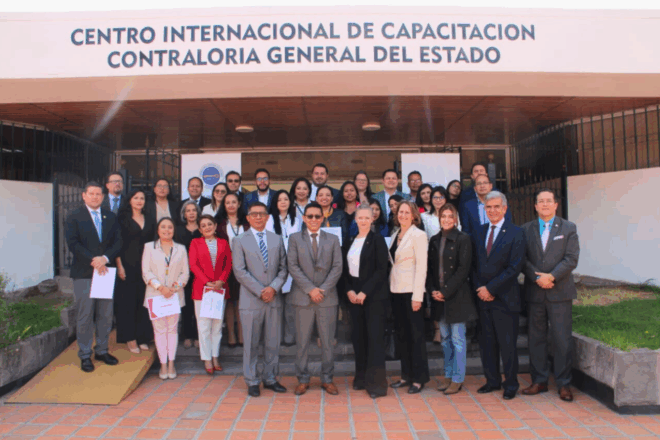
The Canadian Audit and Accountability Foundation (CAAF) is proud to be collaborating with the Ecuador Office of the Controller General (“SAI Ecuador”) to strengthen their capacity to conduct performance audits. The goal is to bring performance audit practices in alignment with the International Standards of Supreme Audit Institutions (ISSAIs), in order to improve transparency, efficiency, and accountability in the administration of resources and public policies in Ecuador. The project is being delivered through the Technical Assistance Partnership – Expert Deployment Mechanism (TAP-EDM) with funding from Global Affairs Canada, in partnership with Alinea International. The CAAF team is fluent in Spanish and highly experienced in capacity building in Latin American Supreme Audit Institutions.
We are excited to be working in Ecuador and its capital, Quito, at 2,850 meters altitude. Ecuador’s volcanoes, flora and fauna are famous around the world. The country has gone through significant change in the last 20 years, with recent energy shortages, increasing rates of violence, and political uncertainty. In 2024, the worst drought in 60 years led to blackouts and electricity rationing nationwide. Improving citizen security and ensuring energy availability in the short term are therefore crucial priority areas.
Our work began with a visit to the SAI in January 2025. Our goals were to understand how the SAI is organized and the types of audits they currently do, and to identify the most important aspects to focus on in our training and mentoring. We came away with a better understanding of the challenges facing the SAI – including the determination to improve its reputation after several difficult years. We met with representatives in all the audit sections, listened to presentations on previous audits, and were suitably impressed by the rigor of the work and the intelligence of the audit staff.
We returned to Quito in March 2025 to deliver five days of training on performance audit methodology and a 2-day train-the-trainer workshop. The training was very well-received. However, questions remained as to how to put it into practice in a challenging context. We held several virtual sessions with the group to support work to update their performance audit manual and start pilot performance audits and made significant progress. We made a final visit in June 2025 to provide in-person support and feedback on planning for the two pilot performance audits, which focus on thermal energy stations and the National Financial Corporation.
SAI Ecuador has a jurisdictional model, which means it can impose sanctions such as fines or suspend pay for responsible managers when there are negative findings. This can make it difficult to develop relationships with auditees that are sometimes crucial for buy-in to audit findings and recommendations. But it does make it very clear who is responsible and what can happen if programs are not carried out economically, efficiently, and effectively. Ecuador does not yet have a legislative committee with responsibility for ensuring audit recommendations are implemented, so this responsibility falls to the SAI itself.
The project ended at the end of June 2025. We hope to have the opportunity to work with SAI Ecuador again in the future!