A Letter from the U.S. Comptroller General and Chair of the INTOSAI Journal
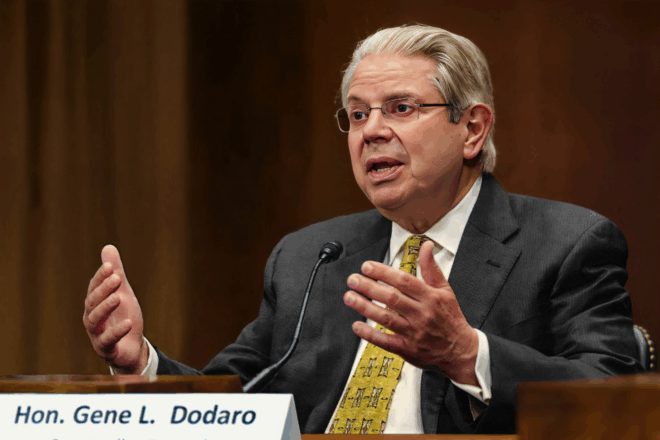
Dear Colleagues,
As my 15-year term as Comptroller General of the United States concludes on December 29, 2025, I want to take this opportunity to reflect on my time as Chair of the INTOSAI Journal and key aspects of GAO’s international engagement. I also want to express my gratitude for the opportunity to serve in this role and collaborate across INTOSAI in promoting the exchange of knowledge, best practices, and news via the Journal.
Throughout my tenure, I have enjoyed and appreciated the opportunity to engage with the INTOSAI community via the Journal; the INTOSAI Governing Board; the INTOSAI-Donor Cooperation; INTOSAI Committees, Task Forces, and Working Groups; and other forms of multilateral and bilateral engagement.
This engagement has been predicated on my belief that effective public sector accountability requires those in our profession to collaborate across borders, share knowledge and best practices, build capacity, and develop and implement sound professional auditing standards.
Fifteen years ago, the Journal was issued quarterly in hard copy and sent via mail to SAIs across the globe. Over time and with the help of the INTOSAI community, we saw opportunities to modernize this model. Through collaboration and innovation, we broadened our reach, leveraged technology, and enhanced the Journal’s capacity to serve the global SAI community.
With the support of the INTOSAI Governing Board, the Journal’s Board of Editors, its Associate Editors, the Board of Directors, and the GAO leadership team, we have transformed the Journal and now reach a larger readership than ever before.
We shifted from publishing on paper to an exclusively online format that continues our tradition of quarterly publications (available for download in pdf format in all 5 INTOSAI languages) while electronically sharing real-time news and updates via our website and social media. We have also enhanced our efforts to provide in-person coverage of key meetings of INTOSAI and its regional bodies to ensure that the Journal’s content reflects the breadth, depth, and knowledge of the entire INTOSAI community.
This approach has enhanced access to the Journal and its valuable resources so that anyone with an internet connection or mobile device can view and download content, and the results speak for themselves.
Since launching a new website in 2023, the number of users has grown 1,365 percent. In the last year, over 141,000 users from nearly every country in the world viewed Journal content. This represents a 73 percent increase in the number of users and a 36 percent increase in the number of pages viewed. Importantly, nearly 30 percent of users access our content using mobile devices and we continually enhance our operations to ensure accessibility across various types of electronic devices.
In addition, the Journal has enhanced its presence at key INTOSAI events, by providing real time coverage via the website and social media. Our social media presence has continued an upward trajectory, with nearly 11,000 followers across platforms.
The Journal also has sharpened its focus on the most important issues facing our profession by publishing thematic issues with useful technical articles that help auditors. These issues have focused on maximizing audit impact, enhancing oversight of public funds through financial audits, use of innovative audit methods, SAI independence, science and technology, women in leadership, severe weather, and the unique circumstances of key segments of our audience, such as SAIs that have jurisdictional duties and those operating on small islands in the Caribbean and Pacific.
This approach has driven interest in the Journal’s content across the globe. I am very pleased that the number of technical articles submitted by INTOSAI members has increased 154 percent over just the last two years.
I am very grateful to everyone who has contributed to the Journal’s success. I encourage everyone in the INTOSAI community to continue contributing to the Journal and sharing relevant information on your knowledge, experiences and best practices. In the future, I am confident that the Journal will continue to grow on the strong foundation we have built.
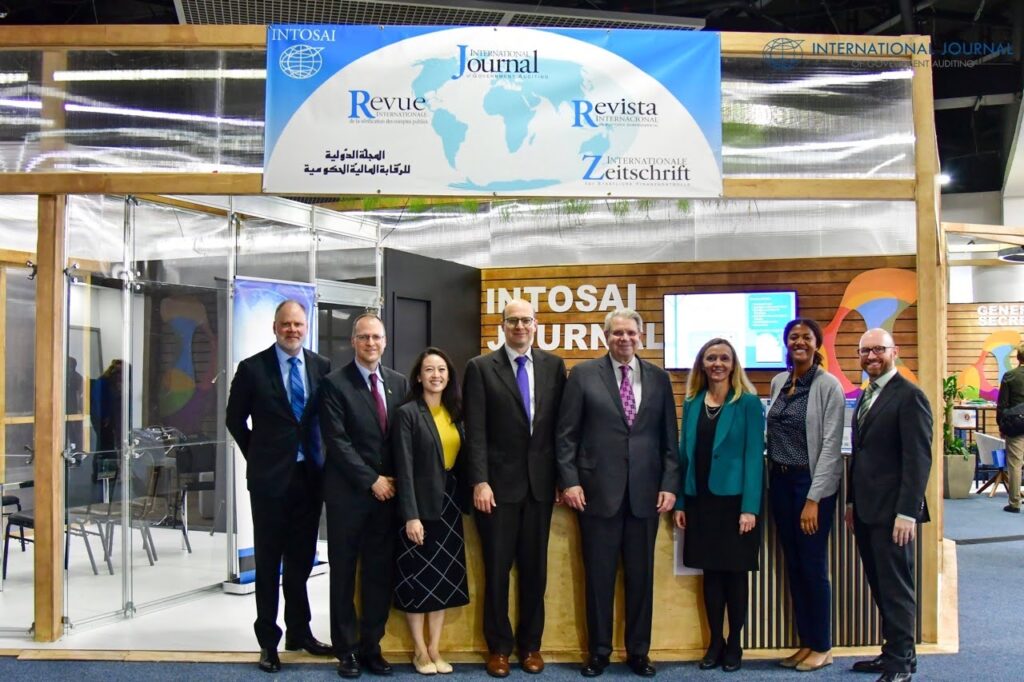
In addition to these reflections on the Journal, I would also like to offer perspectives on four key areas that have been among my priorities for engaging with INTOSAI.
First, as a member of the INTOSAI Governing Board, I have appreciated the opportunity to engage and collaborate with other leaders across INTOSAI and its regions to support sound institutional and financial stewardship while adapting to dynamic conditions and global emergencies.
I have seen many positive outcomes as a member of the Governing Board. For example, INTOSAI’s response to the COVID-19 pandemic illustrates the very best of how INTOSAI’s leadership and members achieved positive outcomes through collaboration and constructive international engagement.
The pandemic posed an unprecedented challenge to the SAI community, as many SAIs around the world were shut down and had limited access to technology. As governments spent the equivalent of trillions of US dollars in responding to the crisis, it was imperative to have well-functioning SAIs to help identify and address possible misuse of public funds and fraud, waste, and abuse.
Working with the INTOSAI Governing Board; the Policy, Finance, and Administration Committee (PFAC); goal chairs; the INTOSAI Development Initiative; and the regions, INTOSAI made available surplus INTOSAI funds to support SAIs in acquiring personal protective equipment and technology to maintain continuity of operations. In total, INTOSAI provided nearly USD 700,000 in grants to 52 SAIs around the world.
As we reported in the Journal in 2022, these efforts yielded positive outcomes across the globe. For example, SAI Nicaragua used the funding to acquire wireless technology, facilitating connectivity across the SAI and its staff while enabling physical distancing. The SAI also acquired key information technology to support video conferences, webinars, and virtual meetings. Similarly, SAI Madagascar was able to acquire information technology that supported remote work, video conferencing, and information sharing via webinars.
Second, I have greatly enjoyed the opportunity to work alongside Dr. Hussam Alangari, President of the General Court of Audit (GAC) of Saudi Arabia and Chair of the PFAC in my role as Vice Chair of the PFAC. Under Dr. Alangari’s leadership, the PFAC has successfully executed its duties in advising the Governing Board on key financial and policy matters while supporting all INTOSAI members and working bodies in successfully executing their mandates.
I am especially pleased with several key outcomes by the PFAC. This includes serving as Chair of the INTOSAI Task Force on Strategic Planning through four planning cycles, as well as working with PFAC colleagues to develop INTOSAI’s first Performance and Accountability Reports and providing stewardship of the INTOSAI Donor-Cooperation.
I view the Donor-Cooperation as particularly important as it helped elevate the needs of INTOSAI’s members with the global development community. INTOSAI established the cooperation in 2009 with the aim of coordinating and facilitating the flow of financial and technical support from donors to INTOSAI members. Working in partnership with IDI, the General Secretariat, GAC Saudi Arabia, the Donor Cooperation Steering Committee, the World Bank and 22 other development partners, the cooperation has now supported over 80 SAIs from all INTOSAI regions.
This support for vital capacity development has leveraged peer-to-peer assistance in areas such as strategic planning, human capital development, enhancements to independence, and specialized training at the regional and SAI levels. For example, the Donor Cooperation is currently supporting SAI Tajikistan in developing a strategic plan, modernizing its audit processes, and forging international partnerships. Similarly, the cooperation is currently helping SAI Belize to enhance its independence while also supporting digitalization of audit and human resources processes.
As we reflect on the Donor Cooperation’s many significant accomplishments and global impact, it is critical that INTOSAI continue to engage with donors and other partners to ensure that SAIs receive the financial and technical support they need to successfully fill their mandates.
Third, throughout my tenure, I have emphasized the need for GAO and SAIs to develop and maintain their expertise in key areas as the speed of technological change affects every aspect of government and society, particularly financial systems. I believe that relevant and impactful SAIs will need to keep pace with changes in science, technology, and data analytics that now evolve at the fastest pace in human history. This has been a major focus of my efforts at the US GAO and my international engagement.
To further these goals, I have worked with the INTOSAI Governing Board to establish working bodies focused on big data, science and technology, and modernization of financial systems. I am very pleased with the positive outcomes achieved by these bodies and the robust participation among INTOSAI members. I encourage all SAIs to take advantage of these valuable resources as they seek to execute their mandates in the best interest of their governments and citizens.
Fourth and finally, I want to emphasize the importance of operational and financial independence for SAIs. In recent years, there has been substantial backsliding in the ability of SAIs around the world to conduct their work free from outside influence. This trend has been well documented by the INTOSAI Development Initiative and the World Bank. As a result, I have strongly supported efforts by INTOSAI and key external partners to promote the independent operation of SAIs.
For example, I have worked closely with the INTOSAI Development Initiative to support the SAI Independence Rapid Advocacy Mechanism, which assesses and publicizes cases of outside interference in the work of SAIs. I am very pleased that this effort has successfully resolved threats to independence in Chad, Cyprus, Croatia, Ghana, North Macedonia, and Poland, among others.
I have also strongly supported collaboration with outside partners to address SAI Independence, including the Donor-Cooperation’s SAI Independence Goodwill Ambassador, the Honorable Helen Clark, former Prime Minister of New Zealand. Similarly, I led INTOSAI’s efforts to engage with the World Bank on this issue, which led to the establishment of the Bank’s SAI Independence Index. The index provides a valuable benchmark of SAI independence in developing countries and creates an incentive for governments to improve their ratings.
The General Auditing Commission of Liberia is a key success story from these independence initiatives. Initially, Liberia’s legal framework did not allow for an independent SAI. The World Bank’s SAI Independence Index drew attention to SAI Liberia’s challenges, resulting in the Liberian government implementing independence principles into SAI Liberia’s 2014 enabling legislation. Liberia is now the most independent SAI in West Africa and is pursuing greater financial independence, which would make it among the most independent SAIs in the World Bank Index. Engagement with GAO has generated substantial support for SAI Liberia within its government and among civil society.
Most recently, I have worked with the Organization for Economic Cooperation and Development (OECD), IDI, the General Secretariat, President of the General Court of Audit of Saudi Arabia and INTOSAI Donor Cooperation Chair Dr. Hussam Alangari, the World Bank, and the International Monetary Fund to assess the factors influencing SAI Independence globally, and enable OECD to consider adoption of INTOSAI’s independence principles as prerequisites for membership. This would provide a strong incentive for governments to ensure that SAIs operate independently.
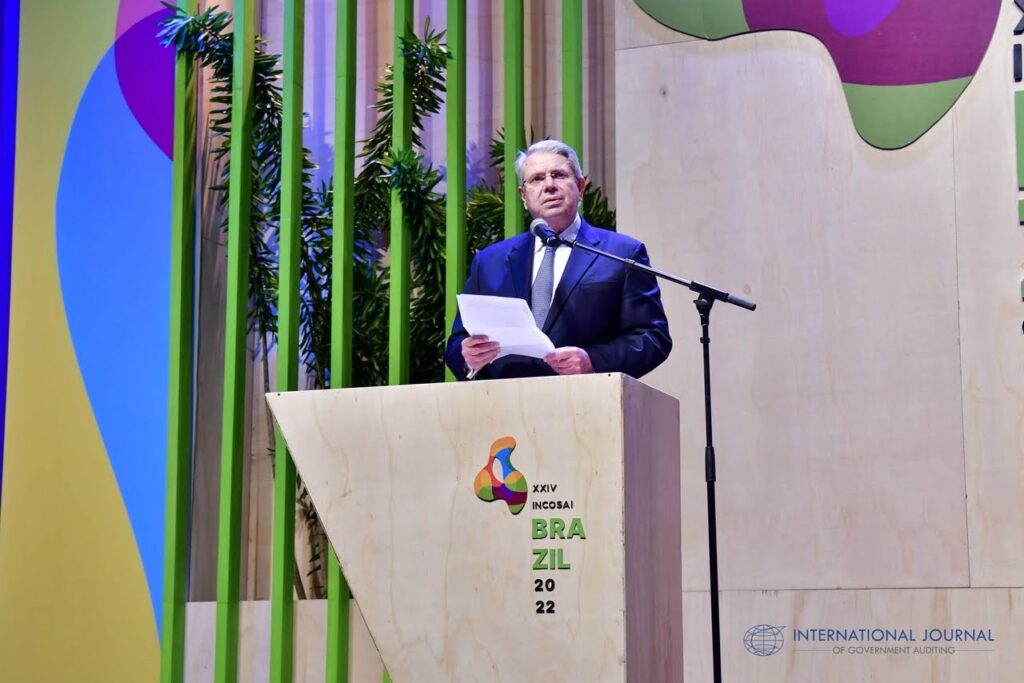
In closing, I want to express my gratitude to all INTOSAI colleagues for the opportunity to engage and collaborate on matters of shared interest. I want to thank Dr. Margit Kraker for her leadership of INTOSAI as Secretary General. Dr. Kraker’s commitment to the global audit community has strengthened good governance and driven meaningful progress in public-sector accountability worldwide.
I view our collective knowledge, ambition, and commitment to public service as a cornerstone of sound governance, public sector accountability, and transparency across the globe. I encourage all members of the INTOSAI community to take full advantage of the myriad opportunities offered through INTOSAI, its working bodies, and the global community of public sector accountability professionals.
It has been an honor and a pleasure to work with INTOSAI during my tenure as Comptroller General of the United States. I wish you all great success in your future endeavors and am grateful for the opportunity to have served alongside all of you in strengthening government accountability at home and around the world.
Sincerely,
Gene L. Dodaro
Comptroller General of the United States
Chair, International Journal of Government Auditing